Sacramento lawmakers reached a compromise wildfire deal over the weekend that largely sidesteps Gov. Gavin Newsom’s push to lighten the financial burden on utility companies whose equipment sparks destructive blazes, a proposal that had drawn fierce opposition from insurers, consumer groups and survivors of last year’s deadly Eaton Fire.
The agreement, announced Saturday, represents a retreat from the governor’s original vision. Rather than reducing what utilities owe insurance companies, local governments and fire victims after their equipment ignites a wildfire, the final package focuses on more targeted reforms — barring private equity firms from investing in wildfire claims and stripping bonuses from utility executives in years when their companies’ equipment causes a fatal fire.
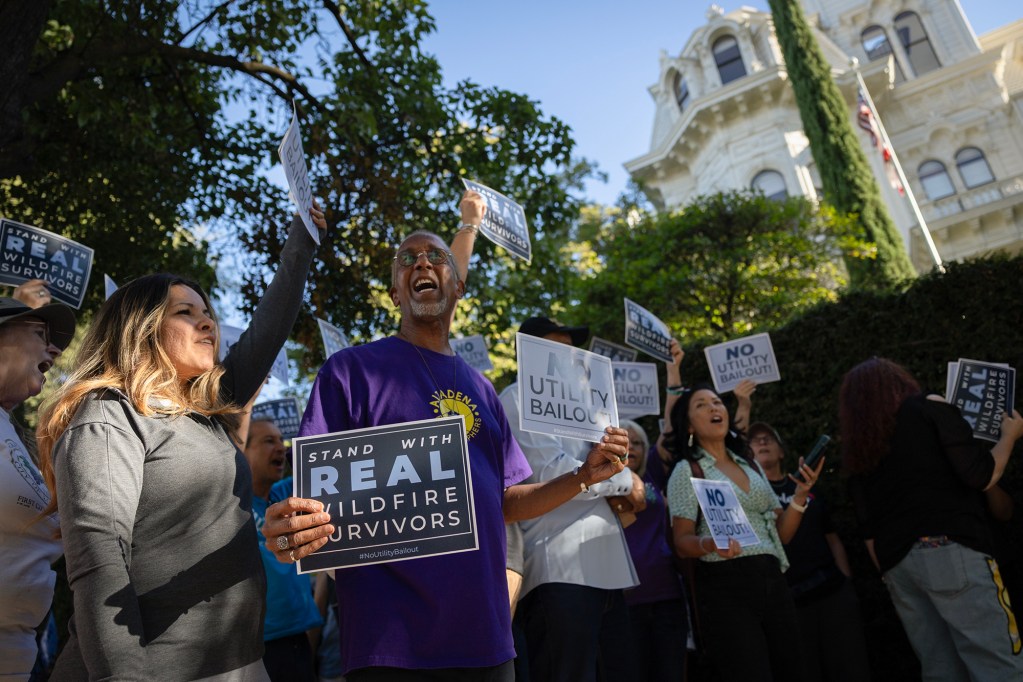
For Inland Empire and Southern California residents who have watched wildfire costs and insurance premiums climb in recent years, the outcome marks a win for legislators who refused to soften penalties for utilities or cap what fire victims can recover. Opposition to Newsom’s original plan came from a coalition that included insurance companies, consumer watchdogs and survivors of the January 2025 Eaton Fire, which killed 19 people in Altadena after being traced to Southern California Edison equipment.
Under the new agreement, formalized in Senate Bill 492, the state will establish a “fast-pay” system to speed compensation for property losses and pain and suffering following utility-caused fires. Insurance claims would need to be evaluated within 60 days, with settlement offers following within 30 days after that — though survivors would still retain the option of pursuing lawsuits against utilities through the courts. The bill also directs the state to strengthen local wildfire prevention efforts and improve transparency around insurance availability in high-risk fire zones.
The deal caps weeks of tense, closed-door negotiations between the governor’s office and legislative leaders over how much financial responsibility utility companies should bear when their equipment sparks a fire. Newsom had sought to reduce what utilities pay to insurers, local governments, businesses and some wildfire survivors, arguing that ballooning costs threaten investor confidence in California’s three major investor-owned utilities — Pacific Gas & Electric, Southern California Edison and San Diego Gas & Electric. Higher borrowing costs for those companies, his administration warned, could ultimately translate into higher electric bills for ratepayers across the state.
The governor also framed his proposal as a way to ensure homeowners who lost everything get paid first, pointing to past wildfire cases in which investors funded lawsuits or bought up claims, injecting third parties into the payout process.
But SB 492 leaves most of those cost-shifting provisions out entirely. The state’s $18 billion wildfire fund — financed equally by utility customers and shareholders, and the same fund that would back the new fast-pay program — remains unchanged in structure. Supporters of Newsom’s original approach warn that another catastrophic fire season could drain the fund, leaving utilities exposed to massive costs and the risk of bankruptcy. Nine of California’s 20 most destructive wildfires on record have been linked to power lines or electrical equipment.
“This system needs full structural reform — not a partial one,” Newsom said in a statement Saturday. He called on lawmakers to revisit the issue next year to shore up the wildfire fund, stabilize electricity rates and prevent fire victims from becoming “unsecured creditors” in the event of a utility bankruptcy.
Sen. Josh Becker, a Menlo Park Democrat central to the talks, said he expects the debate over utility liability to resurface under a future governor. “What I heard very clearly, certainly from senators, from the Assembly and even from all the stakeholders, was that they’re willing to do that,” Becker said. “They’re willing to start getting around the table and looking at some of those structural issues. But that takes time. We ran out of time in this session.”
Sen. Ben Allen, who represents constituents affected by the Palisades Fire, said lawmakers stood firmly behind fire survivors even as the broader issue of electricity affordability remains unresolved. “Challenges with affordability of electricity remain,” Allen said. “That’s not going away.”
Southern California Edison and San Diego Gas & Electric declined to comment directly, instead referring inquiries to Wildfire Victims First, a utility-backed advocacy campaign whose goals mirrored the governor’s original wish list. Campaign spokesperson Nathan Click said the state still needs urgent structural changes “to ensure a fair recovery system.” A PG&E spokesperson said the company is reviewing the legislation and remains focused on speeding survivor recovery, improving safety and protecting customer rates. PG&E’s stock dropped Friday after reports surfaced that a deal without utility cost relief was likely.
Senate President Pro Tem Monique Limón, a Santa Barbara Democrat whose caucus resisted Newsom’s original proposals, said the final agreement “supports survivors in their recovery, curbs Wall Street practices that increase costs on consumers, and mitigates the destruction of these wildfires in the first place.” Assemblymember Cottie Petrie-Norris of Irvine, who led Assembly negotiations, called the deal “an important step forward,” adding, “We held the line to protect the people who needed it most.”
One of the fiercest fights centered on subrogation — the legal mechanism allowing insurance companies to sue utilities to recover wildfire claim payouts. Newsom wanted to eliminate it, but lawmakers rejected that idea, fearing it would destabilize California’s already fragile insurance market, drive up premiums and push more insurers out of the state.
“This outcome keeps costs with the parties responsible for wildfires and helps protect the progress California is making in stabilizing its insurance market,” said Denni Ritter, vice president of the American Property Casualty Insurance Association.
Even so, Sen. Sasha Renée Pérez, who represents Eaton Fire survivors, said insurers shouldn’t escape scrutiny altogether. “We know that in many cases, insurance companies delayed and denied fire survivors’ claims and payments, delaying recovery,” Pérez said. “We need all industries to come to the table in a real way.”
Lawmakers also blocked Newsom’s proposal to cap non-economic damages for survivors — pain and suffering claims that Eaton Fire victims fought hard to protect throughout the negotiations.
Fire survivors and consumer advocates praised the Senate, and Limón in particular, for standing firm against the governor’s proposals. “In the face of extraordinary pressure from some of the most powerful interests in our state, they centered survivors and California families,” said Joy Chen, executive director of Every Fire Survivor’s Network. Consumer Watchdog president Jamie Court described the negotiations as “an exercise in the democratic process,” noting that legislators refused to cave during private talks with the governor’s office.
Pérez credited the survivors themselves with steering the outcome. “The fire survivors have shaped this entire conversation,” she said. “They made a tremendous impact.”
Lawmakers are expected to vote on SB 492 next week.
Original source: CalMatters