
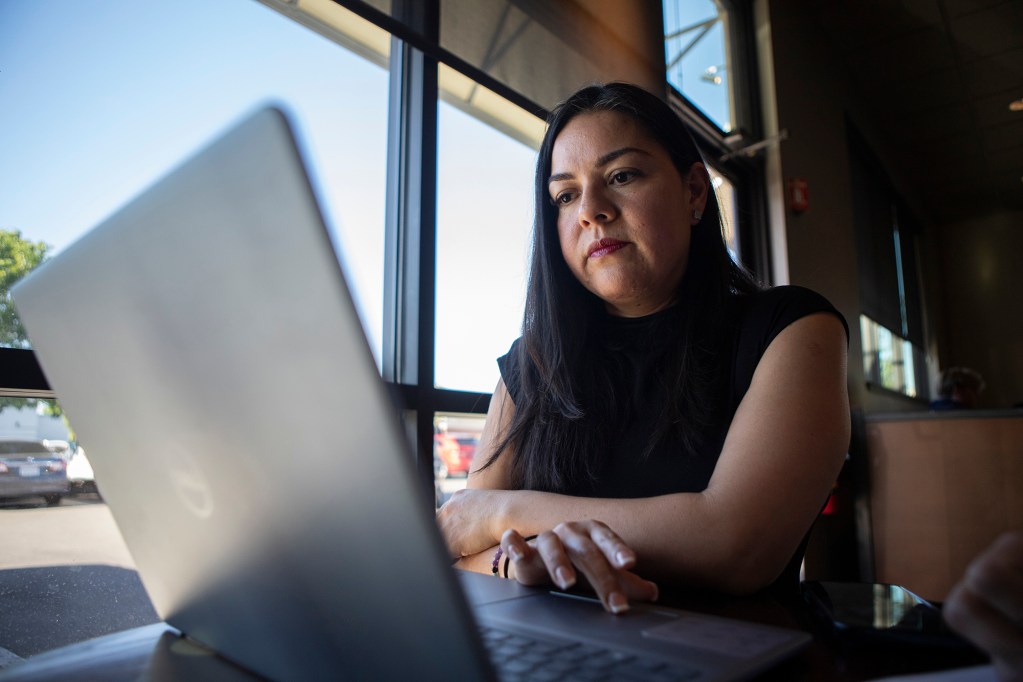
California’s community colleges, the nation’s largest higher education system, are still feeling the aftershocks of the pandemic in a visible way: campuses are quieter, quads are less crowded and many classrooms have moved to kitchen tables and laptops.
More than 2 million students attend California community colleges — about 60 times the undergraduate enrollment of UC Berkeley. Yet since COVID-19 forced colleges online, a large share of instruction has stayed there. About 40% of community college classes in California are now offered online, according to Melissa Villarin, a spokesperson for the California Community Colleges Chancellor’s Office.
College leaders say online courses have opened doors for working adults, parents, caregivers and students who otherwise could not fit college into their daily lives. But students and faculty also describe serious tradeoffs: less interaction, weaker engagement, loneliness, uneven teaching quality and, in some cases, courses that feel more like a checklist than an education.
The shift matters across Southern California and the Inland Empire, where community colleges serve large numbers of working students trying to balance school with jobs, family obligations and long commutes. It also matters financially for colleges. California’s community colleges are funded largely based on enrollment, and surveys show many students prefer the flexibility of online classes, giving colleges an incentive to keep expanding them.
The result is a system still trying to answer a difficult question: Can online education be as effective as learning in person?
For some students, the answer depends heavily on the instructor.
At San Joaquin Delta College in Stockton, student Lupe Archundia said her online microeconomics course relied on prerecorded lectures, some of them more than 10 years old. Quizzes were multiple choice and graded by computer. She said the professor made quiz answers available before students took the tests.
“I am a 39-year-old woman,” Archundia said. “It’s not like I just finished high school and I want easy test answers.”
Archundia works full time as a secretary and has two children. She often studies at night, using cardboard boxes to turn her dining room table into a makeshift standing desk. She is pursuing a bachelor’s degree with hopes of advancing in her career.
At first, she said, she spent about three hours studying before each quiz. After realizing the answers were available, she began taking shortcuts. She earned a high score on the online exam, but said she still does not fully understand some of the material, including elasticity.
She said she feels partly responsible. “I’m responsible, too,” she said.
Research on online education remains mixed. A 2025 study found that students generally perform worse in online courses than in face-to-face classes, though the gap has narrowed. Di Xu, a professor at UC Irvine’s School of Education, said online classes can also help students stay employed while attending school and may improve their chances of eventually finishing a degree.
But online learning places heavy demands on students, Xu said. It requires strong time management and the ability to direct one’s own learning. In a classroom, interaction happens more naturally. Online, especially in asynchronous classes where students watch recorded material on their own schedule, that connection has to be intentionally built into the course.
“If not, the student will feel very lonely,” Xu said.
Most online classes at California community colleges are asynchronous, meaning students do not meet live with an instructor at a set time. Surveys by the RP Group, an education research nonprofit, show students tend to prefer that format even over live online courses.
Archundia said she would rather take classes in person, but evening options are limited, particularly for the English courses she wants. She dreams of becoming a writer and is considering changing her major from business administration to English, but said she is unsure which classes she needs.
When she contacted a counselor in April for help choosing courses, the next available appointment was roughly three weeks away. She still had not found a counseling time that fit around her work schedule.
Alex Breitler, a spokesperson for Delta College, said online courses expand access for students juggling major responsibilities and for many who otherwise could not attend college. He acknowledged that counseling appointments are often booked weeks in advance because demand is high. The college, he said, is trying to respond with online question forms and drop-in counseling options that do not require appointments.
Rebecca Ruan-O’Shaughnessy, director of program and strategy at the College Futures Foundation and a former executive at the California Community Colleges Chancellor’s Office, said advising and support are especially important for online students. But she said colleges need to do more than move traditional classes onto a digital platform.
Online courses should be redesigned for the format, she said, with different structures, stronger support and approaches that recognize many students are adults with work experience and full-time jobs.
“That is the difficult part for community colleges and other institutions,” Ruan-O’Shaughnessy said. “Frankly, they don’t have the incentive to do that level of work, because that’s a lot of work.”
In San Diego County, Cyndi Cunningham enrolled at Palomar College in San Marcos in 2022 after the pandemic disrupted her retail job at a local mall. She was starting college for the first time and took mostly online general education and introductory courses.
She struggled to focus and manage her time. She said she wanted more in-person options but often could not find them.
“I only ended up taking one class in person per semester — not because I didn’t want to take in-person classes — but because I couldn’t find them,” Cunningham said. “I felt like I wasn’t learning; I was just kind of doing tasks.”
She said she also noticed shortcuts from instructors. Two Chicano Studies courses she took were taught by the same professor, and she said he used the same lecture in both classes.
Cunningham has since transferred to Cal State San Marcos, where she is majoring in ethnic studies and plans to become a high school teacher. The difference, she said, has made clear what she missed.
“Even engaging with other students is so much different in person than on a discussion board,” she said. “I realized more how much of a disservice the online classes did.”
Online courses can reduce some expenses for colleges because they do not require classroom space and can enroll more students, Xu said. But quality online instruction often requires additional investments, including faculty training, course design support and specialized counseling.
Online education “has the potential to save a lot of cost,” Xu said, but only if colleges are “willing to sacrifice a lot of the quality elements that are important for students.”
Some disciplines face particular concerns. Julia Simon, a French professor at UC Davis and chair of a university task force on languages, said foreign language instruction is especially difficult to move online. Language classes are typically small and depend on regular speaking practice and cultural exchange.
At the same time, she said, community colleges and UC campuses are expanding online language offerings. Sacramento City College, for example, is offering four French classes in fall 2026, all of them fully online and asynchronous.
“It’s an enormous problem,” Simon said.
Students who complete online language courses may arrive at UC Davis without enough speaking practice, she said. But the university cannot require them to repeat courses they have already passed. Simon said she is considering creating conversation courses that would function as remedial support.
State lawmakers and education officials have spent millions of dollars since the pandemic to improve online instruction. New rules are intended to increase interaction between students and faculty. Colleges have also expanded training for online teaching and hired staff to help design digital courses.
Still, a 2024 RP Group survey found that most faculty members who had taught at least one online class preferred teaching in person.
For Tina Rocha, a 55-year-old Delta College student, online learning has been both a lifeline and a frustration. Rocha began college in 2024 after recovering from three strokes in 2020. Because of her disability, she sometimes needs reminders to submit assignments and accommodations for certain lights or sounds that can affect her vision and cause twitching.
Her creative writing professor, she said, spent a sabbatical studying ways to better teach students with learning disabilities. Rocha said the effort showed. The professor has been patient and accommodating, making the online class a positive experience.
Online education can be a “wonderful alternative,” Rocha said.
Her home reflects the discipline required to manage school remotely. She studies nightly at her dining room table, surrounded by notebooks. A calendar on the wall is filled with notes, and a whiteboard near the entrance lists the week’s responsibilities in color-coded lines.
But another online course, a film class, has been much harder. Rocha said the professor keeps a lava lamp in the background that casts patterns on the ceiling. The visual effect can trigger symptoms for her. When she asked him to turn it off, she said he told her he tried but could not, without explaining why.
Now, when he speaks on screen, Rocha places a sticky note over the image to avoid the effect. She tried to switch into an in-person film class, but by then, only online sections were available.
“It all depends on the professor,” she said.
Original source: CalMatters