‘I felt like I wasn’t learning’: Community college students struggle with online education

Date:

California’s community colleges, the nation’s largest higher education system, are still feeling the aftershocks of the pandemic in a visible way: campuses are quieter, quads are less crowded and many classrooms have moved to kitchen tables and laptops.

More than 2 million students attend California community colleges — about 60 times the undergraduate enrollment of UC Berkeley. Yet since COVID-19 forced colleges online, a large share of instruction has stayed there. About 40% of community college classes in California are now offered online, according to Melissa Villarin, a spokesperson for the California Community Colleges Chancellor’s Office.

College leaders say online courses have opened doors for working adults, parents, caregivers and students who otherwise could not fit college into their daily lives. But students and faculty also describe serious tradeoffs: less interaction, weaker engagement, loneliness, uneven teaching quality and, in some cases, courses that feel more like a checklist than an education.

The shift matters across Southern California and the Inland Empire, where community colleges serve large numbers of working students trying to balance school with jobs, family obligations and long commutes. It also matters financially for colleges. California’s community colleges are funded largely based on enrollment, and surveys show many students prefer the flexibility of online classes, giving colleges an incentive to keep expanding them.

The result is a system still trying to answer a difficult question: Can online education be as effective as learning in person?

For some students, the answer depends heavily on the instructor.

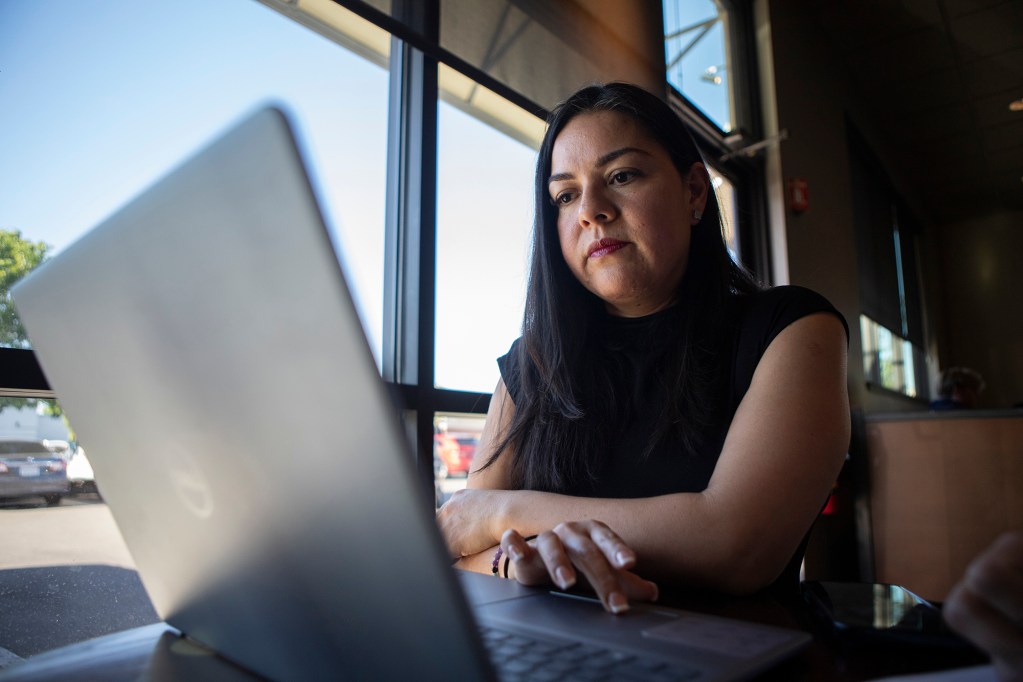
At San Joaquin Delta College in Stockton, student Lupe Archundia said her online microeconomics course relied on prerecorded lectures, some of them more than 10 years old. Quizzes were multiple choice and graded by computer. She said the professor made quiz answers available before students took the tests.

“I am a 39-year-old woman,” Archundia said. “It’s not like I just finished high school and I want easy test answers.”

Archundia works full time as a secretary and has two children. She often studies at night, using cardboard boxes to turn her dining room table into a makeshift standing desk. She is pursuing a bachelor’s degree with hopes of advancing in her career.

At first, she said, she spent about three hours studying before each quiz. After realizing the answers were available, she began taking shortcuts. She earned a high score on the online exam, but said she still does not fully understand some of the material, including elasticity.

She said she feels partly responsible. “I’m responsible, too,” she said.

Research on online education remains mixed. A 2025 study found that students generally perform worse in online courses than in face-to-face classes, though the gap has narrowed. Di Xu, a professor at UC Irvine’s School of Education, said online classes can also help students stay employed while attending school and may improve their chances of eventually finishing a degree.

But online learning places heavy demands on students, Xu said. It requires strong time management and the ability to direct one’s own learning. In a classroom, interaction happens more naturally. Online, especially in asynchronous classes where students watch recorded material on their own schedule, that connection has to be intentionally built into the course.

“If not, the student will feel very lonely,” Xu said.

Most online classes at California community colleges are asynchronous, meaning students do not meet live with an instructor at a set time. Surveys by the RP Group, an education research nonprofit, show students tend to prefer that format even over live online courses.

Archundia said she would rather take classes in person, but evening options are limited, particularly for the English courses she wants. She dreams of becoming a writer and is considering changing her major from business administration to English, but said she is unsure which classes she needs.

When she contacted a counselor in April for help choosing courses, the next available appointment was roughly three weeks away. She still had not found a counseling time that fit around her work schedule.

Alex Breitler, a spokesperson for Delta College, said online courses expand access for students juggling major responsibilities and for many who otherwise could not attend college. He acknowledged that counseling appointments are often booked weeks in advance because demand is high. The college, he said, is trying to respond with online question forms and drop-in counseling options that do not require appointments.

Rebecca Ruan-O’Shaughnessy, director of program and strategy at the College Futures Foundation and a former executive at the California Community Colleges Chancellor’s Office, said advising and support are especially important for online students. But she said colleges need to do more than move traditional classes onto a digital platform.

Online courses should be redesigned for the format, she said, with different structures, stronger support and approaches that recognize many students are adults with work experience and full-time jobs.

“That is the difficult part for community colleges and other institutions,” Ruan-O’Shaughnessy said. “Frankly, they don’t have the incentive to do that level of work, because that’s a lot of work.”

In San Diego County, Cyndi Cunningham enrolled at Palomar College in San Marcos in 2022 after the pandemic disrupted her retail job at a local mall. She was starting college for the first time and took mostly online general education and introductory courses.

She struggled to focus and manage her time. She said she wanted more in-person options but often could not find them.

“I only ended up taking one class in person per semester — not because I didn’t want to take in-person classes — but because I couldn’t find them,” Cunningham said. “I felt like I wasn’t learning; I was just kind of doing tasks.”

She said she also noticed shortcuts from instructors. Two Chicano Studies courses she took were taught by the same professor, and she said he used the same lecture in both classes.

Cunningham has since transferred to Cal State San Marcos, where she is majoring in ethnic studies and plans to become a high school teacher. The difference, she said, has made clear what she missed.

“Even engaging with other students is so much different in person than on a discussion board,” she said. “I realized more how much of a disservice the online classes did.”

Online courses can reduce some expenses for colleges because they do not require classroom space and can enroll more students, Xu said. But quality online instruction often requires additional investments, including faculty training, course design support and specialized counseling.

Online education “has the potential to save a lot of cost,” Xu said, but only if colleges are “willing to sacrifice a lot of the quality elements that are important for students.”

Some disciplines face particular concerns. Julia Simon, a French professor at UC Davis and chair of a university task force on languages, said foreign language instruction is especially difficult to move online. Language classes are typically small and depend on regular speaking practice and cultural exchange.

At the same time, she said, community colleges and UC campuses are expanding online language offerings. Sacramento City College, for example, is offering four French classes in fall 2026, all of them fully online and asynchronous.

“It’s an enormous problem,” Simon said.

Students who complete online language courses may arrive at UC Davis without enough speaking practice, she said. But the university cannot require them to repeat courses they have already passed. Simon said she is considering creating conversation courses that would function as remedial support.

State lawmakers and education officials have spent millions of dollars since the pandemic to improve online instruction. New rules are intended to increase interaction between students and faculty. Colleges have also expanded training for online teaching and hired staff to help design digital courses.

Still, a 2024 RP Group survey found that most faculty members who had taught at least one online class preferred teaching in person.

For Tina Rocha, a 55-year-old Delta College student, online learning has been both a lifeline and a frustration. Rocha began college in 2024 after recovering from three strokes in 2020. Because of her disability, she sometimes needs reminders to submit assignments and accommodations for certain lights or sounds that can affect her vision and cause twitching.

Her creative writing professor, she said, spent a sabbatical studying ways to better teach students with learning disabilities. Rocha said the effort showed. The professor has been patient and accommodating, making the online class a positive experience.

Online education can be a “wonderful alternative,” Rocha said.

Her home reflects the discipline required to manage school remotely. She studies nightly at her dining room table, surrounded by notebooks. A calendar on the wall is filled with notes, and a whiteboard near the entrance lists the week’s responsibilities in color-coded lines.

But another online course, a film class, has been much harder. Rocha said the professor keeps a lava lamp in the background that casts patterns on the ceiling. The visual effect can trigger symptoms for her. When she asked him to turn it off, she said he told her he tried but could not, without explaining why.

Now, when he speaks on screen, Rocha places a sticky note over the image to avoid the effect. She tried to switch into an in-person film class, but by then, only online sections were available.

“It all depends on the professor,” she said.

Original source: CalMatters

LEAVE A REPLY

Please enter your comment!
Please enter your name here

Share post:

Subscribe

spot_imgspot_img

Popular

More like this
Related

The form asked my permission to share my health data. Then it wouldn’t let me say no.

Illustration of Alice from Alice in Wonderland, dressed in a patient gown, falling down a rabbit hole surrounded by buttons that say “I accept” and privacy policies

When Paula Stannard, one of the federal government’s top healthcare privacy officials, visited her eye doctor this year, she was asked to sign a form, acknowledging she’d received a privacy notice about how the office would use her health data. 

“Had I received the notice of privacy practices? No,” she told an audience at one of the nation’s largest health industry conferences in March.

“I did not want to tell them who I was and why they should not be doing that,” said Stannard, who is director of the Office for Civil Rights at the U.S. Department of Health and Human Services. “But I did write a note that says, ‘I have not received this. I am not acknowledging receipt.’” 

Stannard’s story is all too common.

Over the last year, I’ve interviewed more than 20 patients, healthcare providers, experts and advocates about the privacy forms they must sign to get care at their providers’ offices.

Time and again I was told the same thing: Across the country, from large hospital systems to small, private clinics, patients are being asked to sign waivers blindly without knowing exactly what they’re signing.

When patients ask to see more, staff usually don’t have an easy way to show them. When patients do get the forms, it tells them all the ways their medical data will be shared and reused, and some of the ways patients can refuse. But electronic systems make it impossible to opt out on the spot, requiring follow up emails.

Records sharing between unaffiliated providers through these networks can benefit patients by making their scattered records more visible to the provider who is treating them. 

But it can also harm patients.

Patients seeking an abortion may not want records to travel with them from a state where that treatment is legal to one where it is criminalized.

In other cases, companies, such as GuardDog, have admitted to accessing patient records “under the guise of treatment” and funneling them to personal injury law firms.

Researchers have also found healthcare workers snooping through electronic health records. Other dangers include data breaches and serious potential for misuse, such as domestic abusers stalking their partners though the pediatric records of their children.

There’s not much patients can do to limit the risks of their data being available across networks, except by aggressively pursuing opt-outs when providers offer them. Turns out, that can be pretty hard to do. 


Gale Oleson is a retired dermatologist in Missouri who recalled visiting the emergency room after a hand injury.

“They hand me the signature pad,” he said. “They said, you have to sign this so we can do the procedure. And I said, well, I don’t know what the heck I’m signing. Is it like you get my house today? You know, you could be taking my car, you know, signing over my life insurance. And they just laugh, you know?

“… In those situations, I’ve had them either turn the screen to me or I request that they print out a copy for me to review and they’ve always done it, but it’s always a ‘I forgot how a printer works’ kind of thing.”

Experts have a name for this practice: “Dark patterns,” which are manipulative design choices that steer people into doing things or making decisions they otherwise would not make. It’s easier to check the box to say that you’ve received the privacy notice, even if you haven’t. It’s easier to sign the digital signature box, even if you can’t see what you’re signing.

The alternative — saying you didn’t get the privacy notice, or asking repeatedly to see what you’re signing — sounds like a simple request, but can be scary for patients. Many of the patients I’ve interviewed, including a lawyer who works as a privacy advocate, told me they’re afraid that speaking up or pushing back against terms they don’t agree to will make health providers categorize them as inconvenient patients and make it harder to get the care they need.

As a privacy researcher, I’ve experienced this hesitation myself. Last year, I wrote about the epic lengths I went through to get a copy of the consent forms I signed when my toddler needed surgery. When my child was strapped to a movable bed, the surgeon standing there at the ready, I was asked to verify my signature on a consent form. When I asked if I could have a copy of it, a nurse said she wasn’t allowed to give it to me — and sent me to a ghost office at another hospital to search for it. In the moment, I let it go, so I wouldn’t hold up the surgery. Later, after asking multiple people for help, I was finally able to get a copy

To experience more of what patients have to deal with and test whether they’re able to successfully get the information they need, say no, or opt-out of having their data shared, I checked out over a dozen health care systems myself by registering and going to appointments in Iowa, New Jersey, New York, Ohio, Oregon, South Carolina and Virginia.

One telehealth appointment with a provider showed me how easily dark patterns force patients to share their data with big healthcare networks, even when the privacy form they’re signing explicitly says they can opt-out. 

In October 2025, I booked a telehealth appointment with a women’s health clinic in Virginia, after a source was frustrated with the clinic’s check-in process. During registration, I was asked to sign their notice of privacy practices. It’s the same type of form that Stannard never got, but was asked to say she did.

The notice told me that I was giving them permission to let my physician share my health data with a health information exchange, a network that allows providers to search my medical records, like lab results or medical history, from other health organizations when they treat me. These networks can be regional, state-wide or national in reach. The privacy notice says that by signing the form, “you agree to have your medical information shared.” 

It also says I have two other choices:

  • Say no by following instructions on the opt-out form, but there’s no link to the form. 
  • Say yes now and kick off the opt-out process later by sending an email. An email address is provided.

But when I got to the end of the privacy notice, I wasn’t allowed to say no. I had only one choice: “I accept.” After that, there’s a spot to type my name “to accept the policy,” check a box that I understand that I’m electronically signing, and a big button to “Continue.”

The last part of a web form. It starts with an unselected button for “I accept.” Next it reads “Please enter your full name in the textbox below to accept the policy” with an empty box underneath. Next there’s an empty checkbox with text next to it that reads, “I understand that by typing my name and clicking on “Continue”, I am electronically signing this document”. Finally, there’s a button at the bottom that reads “Continue”.
Credit: Screenshot by Alex Rosenblat, CalMatters

I ignored the accept button and tried clicking “Continue.” An error message told me I couldn’t move forward unless I hit “I accept.”

Fields in the form are highlighted in red, with a warning message that reads, “This form is mandatory. Please accept the form to continue.” Another note says “Incomplete required questions.”
Credit: Screenshot by Alex Rosenblat, CalMatters

I was at a crossroads. The privacy notice literally describes “Say No Thanks” as a choice, but doesn’t let me pick it.

At this point, most of the patients I’ve interviewed would probably click “I accept” and move on, even if they wanted to keep their information private. But I was researching what patients have to do for healthcare systems to honor their wishes around consent and privacy, so I stopped filling out the form.

Instead, I emailed the address on the privacy notice. I was surprised that an employee got back to me that day, shared the opt-out request form, and confirmed that “registration is required to opt-in.” She also told me her company, which manages this consent process for the information exchange, will process my opt-out after I sign it and they’re able to process it. The risk is that they might not do it before my appointment. I emailed her back and asked what we should do about this, since the original privacy notice says, “Please note, your opt-out does not affect health information that was disclosed through HIE [health information exchanges] prior to the time that you opted out.” How could we make sure none of my information is shared? 

The next day, she replied that her company would proactively opt me out of the information exchange, that I should still complete the opt-out form she sent me, and that “You should now be able to complete your check-in, and the setting will remain unchanged.”

When I went back to check in for my appointment, I clicked “I accept,” because the health services company assured me nothing will change. Just to be safe, I wrote “I opt out of HIE” and my initials, “AR” into the box where I’m supposed to write my name.

When I wrote to a manager of the women’s clinic about this, they stood by Privia’s process and said that Privia makes themselves available for patients who want to opt-out.

“This is a dark pattern,” said Lior Strahilevitz, a legal scholar at the University of Chicago who has published papers on privacy and dark patterns and teaches health law. In fact, Strahilevitz sees multiple dark patterns in the patient registration process I went through.

One is called an “obstruction dark pattern,” which means the design makes it harder for patients to make any choice except the one healthcare providers want. 

Another dark pattern was “visual interference” where the interface makes it hard on the patient. “The patient’s going to have to face inordinate burdens in order to make an autonomous choice,” he said, because they will need to go “outside the user interface, outside the screens, in order to exercise your opt-out rights.”

Lucia Savage, former chief privacy officer at the federal health IT office, called the Office of the National Coordinator for Health IT, said that problems like this can happen when people carelessly put physical forms online. “This isn’t really a design at all,” she said. “This is just a bunch of paper pasted onto a web page. Could you even really call it design?”

So, is all of this legal?

Legal experts point out that only one element of the check-in process violates the spirit of health privacy law, and it’s not the part I expected.

In Virginia, where I had my appointment, it’s legal for providers to opt patients in at registration and give them a way to opt-out later.

Some states, like Florida and New York, require providers to get a patient’s explicit consent before they can share or access a patient’s data from information exchanges. Other states, like Arizona and Maryland have laws that allow data-sharing through health information exchanges by default, as long as providers tell patients and give them a way to opt-out. Some states have not passed any additional regulations, which means they follow the federal baseline. Federally, under the Health Insurance Portability and Accountability Act (HIPAA), sharing a patients’ data in a health exchange is legal.

According to Sarah Jaromin, a health policy specialist at the National Conference of State Legislatures, in Virginia, there is no current state policy with explicit opt-in or opt-out requirements.

Craig Konnoth, a law professor at the University of Virginia who specializes in health and civil rights looked at the privacy notice I was asked to accept. “You have the choice as to whether your data is going to be used. In this particular situation, ‘we are going to use your data until you file in the opt-out paperwork’ — then that’s actually kosher,” he said. 

What experts say violates the spirit of the law, however, is requiring that patients sign the privacy notice itself. 

When I was checking in, the privacy notice forced me to add my signature and click “I accept” before I could click “Continue.”

“What becomes problematic for me is that you can’t actually proceed. The design forces you to do something that the HIPAA privacy rule does not require you to do,” said Stacey Tovino, a professor who teaches HIPAA privacy law at the University of Oklahoma College of Law. (Full disclosure: As a part of my role as Director of Sociotechnical Research at The Markup and CalMatters, I am combining a broader journalistic investigation with a small ethnographic research studying on digital patient intake procedures, The Markup paid Tovino to consult on the HIPAA implications of my findings, but she did not participate in data-collection or editorial decision-making.)

Nothing in HIPAA requires them to make you sign the notice,” said Tovino. “If they don’t obtain the signature they simply have to document why they didn’t get it.”

There’s an important nuance here. At a doctor’s office, patients usually have to sign and give consent to treatment and financial responsibility policies before they can actually get medical care. But when it comes to privacy notices, HIPAA only requires healthcare providers to ask that patients acknowledge receiving it. Patients should be able to ignore it. 

Many of the privacy-focused patients I interviewed, including those who also work as doctors and nurses, deliberately decline to sign a notice of privacy practices if it contains terms they disagree with. But when modern check-in technology refuses to let a patient move forward without agreeing to the notice of privacy practices, is that legal?

Emily Hilliard, press secretary at the U.S. Department of Health and Human Services (HHS), confirmed that the HIPAA privacy rule does not require providers to get a patient’s consent to their privacy notice, but it also does not “prohibit covered entities from requiring individuals to acknowledge, or agree to the terms of, an NPP.”

In other words, requiring patients to agree to a privacy notice before getting treatment is legal.

“Likely because HHS never envisioned this happening, HIPAA does not explicitly prohibit a covered entity from requiring an acknowledgement of receipt of the notice of privacy practices as a condition of treatment,” said Adam Greene, a partner at the law firm Davis Wright Tremaine who focuses on health information, privacy and security.

“HHS has heard about widespread problems with the acknowledgment of receipt of the notice of privacy practices becoming an obstacle to patient care and a cause of confusion,” he said. “In 2021, they issued a proposed rule that, amongst other things, proposed deleting the requirement for an acknowledgment of receipt of the notice of privacy practices.” The rule was never finalized, but it is back on the agenda this year. 

Stannard confirmed that at HHS, “we are in the process of finalizing the rule which includes some additional requirements for the notice of privacy practices.”

The current proposed rule includes, “Eliminating the requirement to obtain an individual’s written acknowledgment of receipt of a direct treatment provider’s Notice of Privacy Practices.”

Experts say patients should be able to opt out immediately — not eventually

Legal experts say that regulators can fix this problem with one fell swoop: make it a rule that companies must let patients opt-out right away, at the same moment they’re notified that they can.

“Amend these [federal] regulations to say covered entities shall not impose an undue burden on people trying to opt out. Covered entities shall not make it functionally problematic. Covered entities shall not, in registration documents, force people to proceed, thus waiving their right to opt out at the earliest possible time,” Tovino said.

She suggested that when a company notifies someone of their right to opt out, the next sentence should include a link to do so.

Savage agreed that this change would “absolutely” be a substantial intervention. “I believe that’s something OCR [Office of Civil Rights at HHS] could do in regulations.”

At the same event where Stannard shared that her eye doctor asked her to acknowledge a privacy notice she never got, I asked her, “Would updating the privacy rule to require a live link when patients make a choice to opt out or into sharing their information be empowering to Americans as individual patients?” She’d just spoken about U.S. Health Secretary Robert F. Kennedy Jr.’ s agenda “to empower individuals with their own health information.”

“That’s an interesting idea,” Stannard responded. “I don’t remember if we’ve considered it before. It’s certainly something that we could consider going forward.” 

One registration form, but a cocktail of technology companies

Navigating the dark patterns in the check-in process was difficult. What I’ve learned however, is that it’s hard to know who picked that interface to use with patients. Did it come from the clinic or the sprawl of vendors that health facilities have come to rely on? 

Private clinics often partner with multiple outside companies (vendors covered by HIPAA) to get technology and administrative support. My appointment involved three different companies: 

  • The mobile link I received to check-in for my appointment comes from a company named Phreesia, which handles patient-facing software, like consents, medical screening surveys and payment. When a patient clicks through those consent forms in the U.S., it goes through Phreesia every 1 in 6 patient visits.
  • The clinic had joined Privia Health, which handles management services for nearly 5,000 providers across 15 states, which affect 5.2 millions patients, according to a 2025 press release. The privacy notice I struggled with sent me to Privia’s medical records office to opt out. Phreesia’s logo was also on the copy of my forms that the clinic emailed me. 
  • Finally, for my second telehealth appointment six months later, the clinic sent me a link with the name of another vendor, “athenahealth,” in it. The clinic had replaced Phreesia with athenahealth entirely.

“Unless you’re a really giant system,” said Savage, “you don’t have internal expertise on how to do this. So you buy it. You buy what’s plug-and-play and what’s affordable.” 

The Markup and CalMatters asked all three companies who was responsible for the design of the patient registration interface, and no company gave us a clear answer.

Privia: “Privia is committed to the privacy and security rights of our patients’ information and to ensuring we comply with all regulatory requirements regarding our use of that information,” said Robert Borchert, senior vice president of investor and corporate communications at Privia Health.

athenahealth: “athenahealth provides technology that healthcare providers use to manage patient registration and clinical workflows … configured according to each provider’s requirements and applicable law,” read a statement from athenahealth, provided by Nikki D’Addario, senior public relations manager.

Phreesia: “It is the provider’s form and they determine the content and interface options,” said Dori Zweig Young, Phreesia spokesperson.

None of the companies responded to detailed written questions about how much control clinics have over the interface.

A blindspot for regulators and how it can be fixed

Outside of healthcare, regulators, like the Federal Trade Commission (FTC), the Consumer Financial Protection Bureau (CFPB) and multiple state attorneys general and agencies, have called dark patterns manipulative or abusive tactics that confuse consumers about their privacy choices or lock consumers into paying for services (like the famous Amazon Prime case). Researchers consistently find that people want more control over the context of how their data is shared, and that patients are least comfortable handing over blanket access with broad, open consents, even if they are largely willing to share it for specific uses.

Strahilevitz explained, however, that agencies like the FTC and CFPB, which have been the most active on regulating dark patterns, regulate privacy within their zones, and only occasionally take on boundary cases.

“Health privacy, for the most part, is going to be primarily addressed by HIPAA and Health and Human Services rather than the FTC Act and the Federal Trade Commission,” she said.
“There are limits on [the commissions] ability to protect patient privacy because that’s basically another entity’s job.”

Green and Savage both agreed that the Federal Trade Commission has jurisdiction to enforce against dark patterns as unfair or deceptive practices in for-profit healthcare entities. The clinic I went to, like hundreds of thousands across the country, is for-profit. 

But HHS has a broader mandate to regulate healthcare organizations, including non-profit hospitals. 

For example, Strahilevitz said, in consumer finance, regulators at the Consumer Financial Protection Bureau treat a practice as unfair or deceptive when a consumer cannot reasonably avoid the resulting injury. Just as hard-to-cancel online subscriptions force people to pay more, maze-like opt-out structures force patients to pay with their data by default.

Strahilevitz said this provides a framework for thinking about privacy injuries in healthcare. An information exchange could serve as a clearing house for information about a patient’s abortion, which has a clear potential for injury if that information becomes known in a state where abortion treatments are criminalized.

“In other privacy contexts, the courts have said where it’s literally possible to opt out of something but, practically quite difficult, unduly onerous, then we’re not going to treat that as creating an opt-out right,” he said. 

Savage sees more opportunities in carrots than sticks to get to best practices. She argued that the government could invest in good interface design that’s open source and available for anyone to use, and the federal health IT office, where she used to work, could create competitions focused on improving the technical tools that providers buy and use.

If the big technology vendors that independent clinics are already using make these changes, it could affect millions of patients.

State regulation is another possible solution. Strahilevitz said that scrutiny of dark patterns is spreading as states, like California, and regulatory agencies, like the FTC, seek to reign in unfair or deceptive practices through the simple intervention that it should be as easy to cancel as it is to subscribe, with one click.

“I hope that at some point, we’ll get to a point where symmetry of choice is the law of the land, not only with respect to consumer privacy in some states, but to these kinds of medical privacy or financial privacy or other contexts,” he said.

A small fix could make a big difference in Tijuana River pollution: When will it happen?

Water flows across a narrow rural road lined with dense trees and brush. A yellow road sign showing a horseback rider stands near the bend in the road, while sunlight filters through the foliage and reflects off the shallow water covering the pavement.

In summary

As the U.S. and Mexico pursue $800 million in upgrades to wastewater facilities on the border, local officials are working on a smaller fix to improve conditions as soon as next year.

Communities living with one of the most severe pollution problems in California could see immediate relief if San Diego leaders can get a key Tijuana River project out of the gate. 

While millions of gallons of untreated sewage enter the river on a regular basis, one road crossing, known as the Saturn Boulevard hot spot, is the source of most airborne pollution from the river. 

As the U.S. and Mexico pursue a combined $800 million in upgrades to wastewater facilities on both sides of the border, local governments are working on a smaller fix to that chokepoint that could improve conditions as soon as next year, officials said.

San Diego leaders are trying to secure about $25 million to repair the road crossing at Saturn Boulevard, where sewage-tainted water is forced through outdated culverts that spew hydrogen sulfide gas and other toxins throughout south San Diego.

Fixing the hot spot can “mitigate the turbulence in that area, which will mitigate the emissions that basically rocket aerosols into the air,” said San Diego County Supervisor Paloma Aguirre, who has spearheaded efforts to clean up the river.

But they’re still trying to nail down a funding source for the project. 

Sewage pollution from the cross-border river has plagued Imperial Beach, Coronado and other parts of southern San Diego for decades. The threat rose as the Tijuana population grew and wastewater plants on both sides of the border failed, spilling hundreds of millions of gallons of raw sewage into the ocean in recent years.

San Diegans have long known that raw sewage in the ocean is a hazard to swimmers and surfers, and local beaches have been closed for years. Then in 2024, researchers with UC San Diego Scripps Institution of Oceanography discovered that the pollution wasn’t just fouling the water. It was also contaminating the air. 

The river emits airborne chemicals including hydrogen sulfide gas, which cause respiratory problems and other ailments among people in neighboring communities. 

Residents experience asthma, stomach problems, skin rashes and headaches, even without going in the water. Parents are wary about letting children play outside. Local schools enforce “rainy day schedules” to keep students inside when air quality worsens.

Researchers traced the air pollution to the Saturn Boulevard hot spot. It’s a culvert set along a rural road near the Tijuana River. The structure, which includes several large concrete pipes, was built decades ago to divert flood waters from neighboring farm fields. When it rains, water trickles across the road and gushes through the pipes, creating mounds of foam and spraying contaminants into the air.

San Diego County officials are trying to secure money to fix that. They estimate it will cost about $25 million to re-engineer the site in order to control the flow of floodwater and prevent it from releasing toxic gas and airborne particles.

There are several parallel tracks to funding the project, but none of them is certain.

One is a pot of money in Proposition 4, the $10 billion climate bond measure that California voters approved in 2024. It includes about $50 million for border projects on the Tijuana River in San Diego and New River in Imperial County. 

Although it passed two years ago, the funds haven’t been released because of administrative procedures that slowed their disbursement. This year state Sen. David Alvarez, a San Diego Democrat, introduced legislation to waive some red tape and speed up funding through the bond measure. 

With the money now available, the State Water Resources Board will accept grant applications for the funds this summer between June and August, and then score and award them by early next year, said Jennifer Toney, a senior engineer with the State Water Resources Control Board. Local governments and nonprofits working on those rivers are eligible to apply.

The board could award up to $20 million for construction such as the Saturn Boulevard project, Conty said. But it faces competition from other possible Tijuana River efforts such as sediment removal, trash capture and others, as well as proposed projects on the New River, Toney said.

On a separate track, state lawmakers have submitted a request in this year’s state budget for $23 million to cover most of the Saturn Boulevard construction. If that’s approved it could free bond money for other border river projects.

A third possible funding source is a proposed half-cent county sales tax, entitled  “Protect San Diego County Health and Safety Act,”  which goes to voters in November. It could generate $360 million per year, with about $80 million of that earmarked for Tijuana River improvements. 

The measure calls for up to 22.5% of tax revenue to be spent on environmental mitigation to address “the toxic sewage crisis in the Tijuana Valley.” But it doesn’t spell out specific projects such as the Saturn Boulevard site, KPBS reported.

In the meantime, an even quicker temporary solution expected to cost $2.5 million could be in place by this time next year. The temporary fix will extend the existing pipes and transfer the flowing water downstream through an enclosed system, County Public Works Director Marisa Barrie stated in an email to CalMatters. That will reduce the churn that causes pollutants to become aerosolized.

“The team evaluated infrastructure mitigation options at the Saturn Boulevard hot spot and agreed to move forward with a short-term solution that will offer tangible immediate benefits,” Barrie stated.

Design, environmental analysis, and permitting for that project is in the works now, Barrie said. It should take about three months to construct, and county officials hope to complete it by March, 2027, before nesting season for birds in the area. 

Aguirre cautioned that reengineering the culvert won’t clean up the river, but will reduce its impact on neighboring communities. “That’s not the permanent solution to the entire crisis. This is something that’s within our power to tackle, working with the state, city and county of San Diego, that we know based on empirical evidence will bring some relief to residents of affected areas.”

No shame: A last-minute election guide for undecided CA voters

Candidates for California governor stand on stage for the CBS California Gubernatorial Debate at Bridges Auditorium on the campus of Pomona College in Claremont on April 28, 2026. Photo by Jules Hotz for CalMatters

With just a week until Election Day and only 8% of ballots returned so far, millions of California voters are still making up their minds about the election. But here at CalMatters, we listen, we don’t judge — so we have a last-minute voter guide to catch you up on what you need to know, such as:

Who’s ahead in the polls?

The latest Democratic Party poll shows Republican Steve Hilton and Democrat Xavier Becerra leading with 22% and 21% respectively, and Tom Steyer in third at 15%.

What’s an open primary and why do we have it?

California’s open primary allows the two candidates who receive the most votes to move on to the general election in November, no matter what party they belong to. The state adopted this system after voters approved Proposition 14 in 2010, which allows voters to pick any candidate in a primary, regardless of their own party affiliation. 

This system allows two candidates from the same political party to potentially advance, which is a real possibility this year because of the sheer number of candidates running for governor and the fact that there’s no clear frontrunner.

Is it too late to vote by mail?

Mailed ballots must be postmarked on or before Election Day and received by election offices within seven days. To make sure your ballot is counted, it’s best to mail your ballot at least five days before June 2, or Thursday.

How can I vote on Election Day?

Besides mailing it in, you can submit your ballot at a drop-off location or vote in-person at the polls from 7 a.m. to 8 p.m. Find your nearest polling place here and your closest ballot drop-off location here.

Check out our last-minute voter guide here. And for more comprehensive info, read CalMatters’ full voter guide, which has the lowdown on other statewide offices, state legislative races and congressional elections, as well as a governor Q&A with the leading candidates.


We’re bringing our voter guide to life through VotingMatters events across California this month, in collaboration with on-the-ground partners: Local news organizations, colleges and nonprofits. Our next event is this evening in Merced and Fresno and Wednesday in Modesto. Plus, we have a DIY kit to host your own event.


Worst threat at Garden Grove chemical tank is over, officials say

Steam rises from industrial tanks and pipes at a fenced facility site. A large rust-streaked white storage tank stands beside smaller cylindrical tanks releasing vapor, while construction materials, scaffolding and a blue container occupy the foreground. RVs and trailers are parked beyond the facility in the background.
Water is sprayed on a damaged tank at GKN Aerospace in Garden Grove on May 24, 2026. Photo by Ethan Swope, AP Photo

The most catastrophic threat from a chemical emergency that forced 50,000 Orange County residents from their homes has passed, fire officials said Monday — but risks and questions remain.

  • Craig Covey, Orange County Fire Authority division chief, in a statement: “The tank has released its pressure. Additionally to that, the temperature has been stabilized and actually reducing. … That is incredibly positive news as we turn the corner on this incident.”

Crews continue to monitor a cracked and damaged 34,000-gallon tank at the GKN Aerospace facility in Garden Grove, after the company first reported a vapor release last week. Gov. Gavin Newsom declared a state of emergency in Orange County, and President Donald Trump signed a federal emergency declaration after Newsom requested federal assistance. 

Meanwhile, Orange County District Attorney Todd Spitzer opened a criminal investigation, deployed drones to survey the site and ordered GKN Aerospace to preserve its records against potential litigation. At least one couple who was evacuated is suing the company for negligence. 

CA courts are putting AI to work. Any objection?

A view of the front facade of a courthouse in Los Angeles, with the sunlight reflecting off the building and a pole with an American flag waving in the air in front.
An American flag waves outside the Los Angeles Superior Court in Los Angeles on Feb. 11, 2026. Photo by Ethan Swope, Getty Images

Two of California’s largest courts are experimenting with a new artificial intelligence tool and considering whether it can be used in high-stakes criminal cases.

So far, superior courts in Los Angeles and Riverside counties are primarily using the tool made by the company Learned Hand for civil cases. It can help research attorneys draft orders and write research memos.

  • Samantha Jessner, L.A. County superior court judge: “I think we have a duty and obligation to explore whether or not there is a place for artificial intelligence in what we do as a judicial branch and that’s exactly what this pilot is intended to afford us the opportunity to do.”

But CalMatters’ Cayla Mihalovich and Khari Johnson report today that use of AI in courts has been controversial because of the propensity of AI models to cite falsehoods and to produce sycophantic text. They also learned that L.A. judges floated using the tool to evaluate appeals from people who believe their conviction or sentence was tainted by racial bias.

Officials from L.A. County Superior Court said those decisions are months or years away, and will only be made after thorough testing.

Read more.


Other things worth your time:

Some stories may require a subscription to read.


Khanna says Dems should run against Supreme Court after voting rights ruling // San Francisco Chronicle

He name-drops Ocasio-Cortez in his bid to succeed Pelosi in Congress. She doesn’t talk about him at all // The New York Times

After purge of judges forced SF immigration court to shut, asylum cases in chaos // Los Angeles Times

Equity advocates to ask CA court to suspend billions in school construction funding // EdSource

Four ways Silicon Valley billionaires are influencing the election // The San Francisco Standard

Rising diesel prices pinching profits for CA farmers, spiking costs for consumers // The Fresno Bee

LA is safer than it’s been in decades, but crime is an issue dominating the mayor’s race // Los Angeles Times

California judges are testing a new AI clerk, and you won’t know if it’s looking at your case

A view of the front facade of a courthouse in Los Angeles, with the sunlight reflecting off the building and a pole with an American flag waving in the air in front.

In summary

Courts in Los Angeles and Riverside counties are testing an artificial intelligence tool and deciding whether it can be used in high-stakes criminal cases.

Two of California’s largest courts are testing an AI tool that can draft orders and produce research memos. 

Judges so far are using it primarily for civil cases, but documents obtained by CalMatters indicate the possibility of expanded applications in criminal cases, where people’s freedom and access to justice are on the line. 

The Los Angeles County Superior Court began a pilot program in February to test a tool created by the company Learned Hand. Other courts may follow, according to Learned Hand founder and chief executive officer Shlomo Klapper.

Learned Hand uses a combination of language models from Anthropic, OpenAI and Google to act as an AI clerk for judges. The company says it tests for bias and accuracy, but it has not yet published results. 

In Riverside County, which has a $10,000 agreement with the company to test the program, civil and probate attorneys are primarily using the tool to draft research memos that help judges reach their decisions. It’s typical for research attorneys to assist judges as they review cases.  

Los Angeles County Superior Court has a roughly $314,000 contract that includes a roadmap to test the tool’s use in criminal, family and probate divisions. Officials would not describe in detail to CalMatters the criteria they’re using to evaluate whether use of the tool can safely expand to criminal and family courts, where the stakes are often much higher than in civil cases. 

One judge who spoke to CalMatters on condition of anonymity due to judicial rules of conduct was alarmed when their colleagues at a recent luncheon said the technology could be used one day to evaluate appeals from people who believe their conviction or sentence was tainted by racial bias. California courts are handling a wave of those claims after lawmakers passed the Racial Justice Act in 2020. 

“I think it is outrageous,” said the Los Angeles County Superior Court judge. “AI cannot and never will be able to replace human judgment in evaluating complex social dynamics. Ultimately, that will erode the public’s confidence in the competence and fairness of the judiciary.”

A majority of California’s superior courts now have generative AI use policies, according to documents obtained by CalMatters via public records requests, which they were required to create by the state Judicial Council before using the technology. Roughly a dozen of the 51 courts that have responded to CalMatters’ requests said they are using AI-powered tools from LexisNexis, Thomson Reuters, and Microsoft’s Copilot.

Use of AI in courts has been controversial because of the propensity of AI models to cite falsehoods and to produce sycophantic text. Models from major companies like Google and Anthropic can reduce critical thinking and brain activity, according to a 2025 MIT study.

Language model hallucinations have already made it into the judicial system. Researcher Damien Charlotin has documented hundreds of instances of litigants, lawyers, and judges making mistakes when using AI to do their jobs including nearly 90 cases in state or federal courts based in California since August 2024. 

Last fall, a Los Angeles-based lawyer received a historic $10,000 fine for citing cases that don’t exist, and earlier this month the Sacramento Bee reported that use of AI led to errors in four cases handled by prosecutors in Nevada County. Most of these cases involve lawyers or people who are representing themselves in court, but UCLA Law School professors predict that more judges will make AI-fueled mistakes in the future. In recent months, the U.S. Senate investigated federal judges in Mississippi and New Jersey for drafting decisions with generative AI that had serious factual errors. 

Klapper, who previously worked as a clerk for a federal appeals court and for surveillance technology company Palantir, said the judiciary needs AI in order to reduce backlogs and increase efficiency.

“Could we hire more people?” he told CalMatters. “Maybe, but it’s not going to keep pace with the exponential increase that’s coming, nor is it going to be able to adequately solve the crisis of today. I think the only solution is to give every single judge and staff attorney their own AI clerk.” 

Klapper said he’s aiming to combine the best parts of what human judges can do with the best parts of what machines bring to bear. 

“I’m not saying all machines aren’t biased,” he said. “I’m not saying my machine isn’t even biased. I’m saying we can test it and people have tested it. And that is the benefit over humans.” 

Generative AI use policies for the Los Angeles and Riverside County superior courts only require disclosure if a motion, decision, or other document is written entirely with generative AI. 

Both courts refused to say whether plaintiffs are aware that the tool is being tested on their cases. In a statement to CalMatters, a spokesperson for the Los Angeles County Superior Court said testing is done on motions that have already been decided, separate from live case environments. However, the contract allows for testing on live cases.

“It is important to note that even with successful evaluation and thorough testing, the Court remains several months, if not years, away from implementing this type of tool,” said the spokesperson. 

The contract allows the tool to be used for two critical motions in the criminal division: A motion to suppress, which is designed to determine what type of evidence the prosecution is allowed to present at trial, and motions for post conviction relief, which are filed by people who have already been convicted and want another shot at freedom. 

That’s the “greatest concern” for Los Angeles County District Attorney Nathan Hochman. When he reviewed the contract, he referred to the motions as “two incredibly important motions in the criminal justice system.”

“When you’re dealing with someone’s liberty — as opposed to in the civil setting, which is everything other than liberty — the stakes couldn’t be higher,” said Hochman. “I don’t want to take the chance, particularly in a criminal case, that AI happens to get it wrong. And now someone’s constitutional rights have been infringed. Someone has gone to prison who shouldn’t have, or on the flip side, that somehow someone gets off.”

‘An extremely perilous road’

In Los Angeles, some judges first heard about the new Learned Hand contract during a March presentation by Superior Court Judges Yvette Verastegui and Olivia Rosales. They lead the criminal branch and visit courthouses throughout the county as part of an annual roadshow, where they update judges on court operations, discuss workload and field questions. During a luncheon, Verastegui and Rosales said the tool could be used to assist with Racial Justice Act petitions in the future. 

California’s Racial Justice Act allows people to challenge a criminal conviction or sentence that they believe was based upon racial bias. Petitions are filed directly to the court from people in state prison. If a case is found to have merit, the process includes appointing legal counsel, filing briefs and setting evidentiary hearings before a judge would decide whether to grant the petition. 

That process could look different with a tool like Learned Hand. Verastegui and Rosales explained that, following an incarcerated person’s petition, the tool could generate tentative decisions for judges to consider in denying or advancing cases to the next stages, according to one judge who attended the luncheon. 

“The concern, of course, that I have is that the courts will utilize that as a reference point and then get stuck to that initial analysis,” said the judge. “It’s an extremely perilous road to go down. Putting aside the inaccuracy, which will be a significant concern, it dehumanizes the whole process. It does not treat people as individuals with lived experiences. It essentially reimposes a one-size-fits-all style of justice.”

A second Los Angeles Superior Court judge who spoke with CalMatters on the condition of anonymity remembered the presentation and said they would not trust nor use the tool to summarize a Racial Justice Act petition.

AI can replicate or intensify patterns contained in the data used to make a model, including human biases. Large language models have a history of demonstrating race and gender bias, an analysis of predictive policing tech used by LAPD found racial bias, and an analysis of the risk assessment algorithm COMPAS found that it is more likely to label Black people as at risk of committing crimes after incarceration than white people with a similar record. 

Public defenders who spoke with CalMatters echoed those concerns. 

Elizabeth Lashley-Haynes, a deputy public defender at the Los Angeles County Public Defender’s Office, said it would be “highly problematic and bordering on unethical” for a judge to use the tool to review Racial Justice Act petitions, which she described as “incredibly nuanced.”

“They’re like nothing else in the legal system that has ever really been done,” said Lashley-Haynes, who specializes in Racial Justice Act cases. “Words that are used in these cases that have racial undertones or racial meanings are way beyond the realm of anything that artificial intelligence could do.”

In interviews with CalMatters, Klapper and Los Angeles County Superior Court Executive Officer, David Slayton, denied that the court has any plans to use the tool for Racial Justice Act petitions. A spokesperson for the Los Angeles Superior Court later confirmed in an email to CalMatters that the contract permits the tool to be used in such a way “but that possibility has not commenced in any way.” 

Klapper said if they were to build out a Racial Justice Act module, the tool would need to be evaluated for bias and co-developed with the court. 

“The timing very fortuitous, right?” he said. “It’s a very fraught decision, I’m not going to lie…extremely high stakes — a scenario where I understand people might be very concerned. Especially with criminal, I have even more hesitancy, even more guardrails than normal about, because there are liberty interests at stake.”

Extending beyond civil cases

In Los Angeles, six superior court judges and their research attorneys are primarily using the Learned Hand tool to conduct research, summarize motions and assist in drafting tentative rulings, according to Slayton. He says the tool won’t move beyond the civil division “until the court leadership is comfortable.” 

“The court is being very deliberate and careful about how we use technology like this,” he said. “So until we evaluate it and determine that it is effective in those areas, we will not extend it to other areas.” 

The exterior of the Hollywood Courthouse, a beige concrete building with a large arched window above the entrance. The sign reads “Hollywood Courthouse, Superior Court of California, County of Los Angeles.” Tall trees frame both sides of the building, and the sky above is overcast.
Los Angeles County Superior Court’s Hollywood Courthouse, in Los Angeles, on March 12, 2025. Photo by Jules Hotz for CalMatters

The tool will be evaluated on a quarterly basis to determine its future application, Slayton said, but he did not specify what kind of evaluation that entails. In an email to CalMatters, a spokesperson later said that Learned Hand is evaluated “against the same substantive expectations applied to law clerks and research attorneys: accurate legal research, sound analysis, neutral and judge-ready writing, and reliable work product that supports judicial decision-making.”

Los Angeles County Superior Court Judge Samantha Jessner, who chairs the Judicial Technology Advisory Committee, said she was unaware of the possibility that the tool could eventually be used outside of the civil division until recently. Judges are not privy to contract negotiations due to certain ethical limitations, she said. 

“I think we have a duty and obligation to explore whether or not there is a place for artificial intelligence in what we do as a judicial branch and that’s exactly what this pilot is intended to afford us the opportunity to do,” said Jessner.

Riverside County Superior Court signed an agreement with Learned Hand in February. In emails obtained by CalMatters, Klapper proposed to two Riverside County Superior Court executives, Jason Galkin and Sarah Hodgson, that the court use the tool for a common civil court motion and “then expand quickly once we earn our stripes.” He suggested that Hodgson assemble a list of motions and workflows “that generate the most pain,” citing examples that included the Racial Justice Act. 

Roughly two weeks later, Hodgson described the most laborious motions “that want to drive us into retirement,” including discovery motions and attorney fee motions. For criminal cases, the court suggested that Klapper focus on “things with the largest paper records,” citing death penalty habeas petitions and parole revocation.

Since the pilot started, seven civil and probate attorneys have been granted access to the tool. Galkin, the chief executive officer of the Riverside County Superior Court, said they are “kicking the tires on the product” to see what tasks it can do. The tool is not being used to draft tentative rulings, he said. 

“We don’t even know if expansion is likely so there is no set criteria for what expansion might look like or thresholds for that because right now, the core question is: Does this help staff and does it advance what they’re trying to do in their roles?” said Galkin.

As testing is underway, attorneys like Hochman say that use of AI is inevitable, but would be better suited for low-level, repetitive and routine tasks.

“It’s the analysis of the case itself, coupled with the conclusions that will be reached, that I’m very hesitant to trust AI at this point — in large part, because I don’t know all of the inputs that AI is using to make its decision. The only thing I’m 100% sure of is that AI didn’t go to law school,” said Hochman.

Cayla Mihalovich is a California Local News fellow.