Witness: Police requested an unlicensed bail agent to give cover before he killed a man

Date:

A police officer requested “lethal cover” before an unlicensed bail agent opened fire and killed a man wielding a knife in Palm Springs, a prosecution witness testified in a preliminary hearing today.

Fabian Hector Herrera, 36 years-old, was arrested on April 23 for the shooting death of 33-year-old David Spann. The shooting occurred on the same day at about 2:30 a.m. in the 100 block of East Via Escuela. Authorities say he fired the fatal shots after Spann, wielding a knife, lunged toward him and several police officers inside his home.

Herrera has pleaded not guilty to charges of murder and for being a convicted felon in possession of a gun, body armor and ammunition, along with multiple sentence-enhancing allegations. Herrera’s attorney alleges that his client fired the shots only after being ordered to do so by Palm Springs police officers.

Herrera’s preliminary hearing is scheduled to resume on Sept.20 at the Larson Justice Center in Indio and he is being held at the Robert Presley Detention Center in Riverside on $2 million bail.

His mother, Lisa Roberta Vargas, 53, was arrested May 20 in connection with the shooting death of Spann.

Vargas is scheduled for a felony settlement conference Oct. 12. Along with murder, Vargas is charged one felony count each of delivering a firearm to a person prohibited from possessing one, and committing perjury by false affidavit. Herrera and Vargas face potential life sentences if convicted as charged.

The sheriff’s department reported that while Spann was wanted by a bail agency, there was no warrant for his arrest issued by a law enforcement agency. Herrera, was “not properly licensed” as a bail agent, and was also prohibited from possessing firearms due to his criminal history, according to sheriff’s officials.

Herrera has two felony convictions, both for assault with a deadly weapon, one in Los Angeles County and the other in Riverside County, court records show.

Herrera’s preliminary hearing was scheduled for a second day so that the owner of the bail agency that allegedly hired Herrera and Vargas can testify.

Jail records show Spann posted a $100,000 bond April 1 in a misdemeanor restraining order violation case, although it remains unclear why he was being pursued by the defendants.

Deputies were initially sent to the Via Escuela location on a report that a bail agent needed assistance in apprehending a fugitive, according to Palm Springs police. Prior to officers being dispatched, police said they spoke to Herrera multiple times, once with him reporting he had planned to arrest the fugitive, and another to say the suspect was holding a knife and that he needed help.

Officers also received a call from Spann himself, who said someone was trying to break into his home, along with a call from Spann’s alarm company to report the same incident.

During the preliminary hearing today, Riverside County Sheriff’s Department Deputy Jarred Bishop provided a timeline of the calls, testifying that Herrera called the Palm Springs Police Department to report that he intended to arrest Spann. The next call to be received was from Spann and his alarm company, reporting the break-in. Bishop testified that Palm Springs police were able to recognize the connection and attempted to reach out to Herrera. When Herrera picked up the phone, Bishop alleges that he reported having Spann at gunpoint and was requesting backup from Palm Springs police.

Once on scene, officers contacted the knife-wielding suspect, who refused orders to comply, prompting an officer to use a stun gun on the man, but he continued to defy officers’ orders, police said.

During the preliminary hearing, body camera footage from the officer showed the attempt to use a stun gun on Spann, but prior to doing so, audio from the video plays in which the officer tells Herrera “you got lethal.” Bishop testified that this statement was a request for lethal backup, in which, prior to attempting to use non-lethal force, an officer requests a second officer to be prepared to use lethal force in the event that non-lethal force does not work in containing the suspect.

According to Bishop, the officer believed Herrera to be a fellow officer despite Herrera calling the initial incident in as a “fugitive recovery agent.”
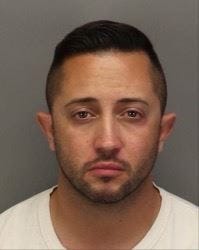
Fabian Hector Herrera: Arrested on April 23 for the shooting death of 33-year-old David Spann. | Riverside County Police Department.

Bishop testified that the only one of the two prongs from the officer’s stun gun lands on Spann, and that Spann then gets up and continues to move towards the officer with the knife.

Audio from the footage can then be heard in which the officer says “shoot” and it is then when Herrera shots Spann, according to Bishop’s testimony and the clip played in court. It was disputed by the prosecution attorney as to whether the word “shoot” was meant to be an order to Herrera or simply an exclamation of the stun gun not working on Spann.

Spann was pronounced dead at the scene despite life-saving measures performed by first responders, according to police. No Palm Springs police officer fired a lethal weapon, officials said.

Because Palm Springs police were present during the shooting, investigators from the Riverside County Sheriff’s Force Investigations Detail were called in to spearhead the investigation, and later arrested Herrera and Vargas.

KESQ | Contributed

Find your latest news here at the Hemet & San Jacinto Chronicle

LEAVE A REPLY

Please enter your comment!
Please enter your name here

Share post:

Subscribe

spot_imgspot_img

Popular

More like this
Related

Democrats Pledged Neutrality in California Race, Then Chose Sides

National Democrats are zeroing in on California’s 22nd Congressional...

Newsom’s unbalanced budget faces strong pushback for spending cuts. Will lawmakers back him?

Gov. Gavin Newsom’s proposed state budget is drawing mounting...

CA colleges try to improve online classes

A person wearing a blue shirt and glasses is working on a laptop at a kitchen table, with books and school materials scattered around, in the corner of a kitchen in a home. In the background, a framed painting hangs directly above the person as they work, while in the foreground is a view of a kitchen cabinet.
Student Tina Rocha sorts through her classwork at her home in Stockton on May 7, 2026. Photo by Larry Valenzuela, CalMatters

Online college classes can be impersonal, isolating and disengaging. But with high demand among their students for online learning, California’s community colleges and universities are trying to find better online teaching practices.

As CalMatters’ Adam Echelman explains, about 40% of all community college classes are online. Online courses enable students, especially those who are part- or full-time workers, to complete their degree while juggling jobs, caretaking responsibilities or other obligations.

But taking these courses also requires “self-directed learning skills,” including a “very high level of self-time management,” said Di Xu, a professor at UC Irvine’s School of Education. 

  • Xu: “In an in-person environment interaction happens naturally. But in an online environment, especially asynchronous, that opportunity needs to be embedded. Otherwise, the student will feel very lonely.” 

Students prefer online courses, and they’re less costly for colleges to offer than in-person ones.

Rebecca Ruan-O’Shaughnessy, the director of program and strategy at College Futures Foundation and a former executive at the California Community Colleges Chancellor’s Office, said schools need to adapt. Some new approaches she cited as promising include shortening the length of classes or trying to integrate adults’ work experience since so many online students have jobs.

To address some of the shortcomings of online foreign language courses, Julia Simon, a professor of French at UC Davis and the chairperson of a task force on languages for the university, is considering creating a set of conversation classes.

Simon said students who take online courses miss out on opportunities to practice speaking. Once students enter UC Davis, they’re unprepared, she said. But since “we can’t make them repeat courses they’ve already had,” Simon said, a conversation class could be offered as remedial education to help students catch up.

Read more.


We’re bringing our voter guide to life through VotingMatters events across California this month, in collaboration with on-the-ground partners: Local news organizations, colleges and nonprofits. Our last event is this evening in Modesto. Plus, we have a DIY kit to host your own event.


Competition at the Board of Equalization

An outer view of a white and black semi-spherical dome that sits on top a white building decorated with various architectural details.
The state Capitol on March 28, 2025. Photo by Miguel Gutierrez Jr., CalMatters

We know that Californians are curious about elections at the Board of Equalization this year. Our page for that contest is drawing the second-largest audience in our voter guide, second only to the governor’s race.

That’s surprising considering the agency’s funny name and its fairly narrow portfolio in the world of California taxes. The agency had a lot more power until 2017, when then-Gov. Jerry Brown signed a law stripping it of almost all of its employees and authority.

  • Betty Yee, former state controller: “I just really do question how this board continues to have relevance.”

But we can also see that the races for the four board of equalization seats are going to be competitive. Three current lawmakers are running for open seats, and a former assemblymember is up for reelection.

  • State Sen. Tom Umberg, who is running for a seat on the board: “Although it’s not a high-profile job, it’s a critically important job, especially when we’ve got so many revenue challenges in California.”

Read more on the race here.

$25M needed to clean up polluting road

Water flows across a narrow rural road lined with dense trees and brush. A yellow road sign showing a horseback rider stands near the bend in the road, while sunlight filters through the foliage and reflects off the shallow water covering the pavement.
Flooding caused by the Tijuana River covers a section of Saturn Boulevard after a rainy day in San Diego on Nov. 21, 2025. Photo by Adriana Heldiz, CalMatters

The Tijuana River is severely polluted. When it rains, the river waters rise and flood part of Saturn Boulevard in San Diego. The part of the road the polluted waters flood exacerbates the already dire situation, spraying contaminants into the air. 

Fixing this particular situation — not solving the river’s pollution but curbing some of the negative health effects caused by the pollutants becoming airborne — would cost $25 million, reports CalMatters’ Deborah Brennan. The positive effects of the repair could be felt as soon as next year, according to San Diego County officials, but coming up with the cash will be a challenge. 

Lawmakers submitted a request in the state budget to cover $23 million, and its possible money from 2024’s $10 billion Proposition 4 could be drawn upon, as well as increasing the county sales tax. 

Read more.

And lastly: CA’s ICE ID requirement

A group of heavily armed federal agents in full tactical gear emerge from the back of an armored vehicle labeled “LENCO ARMORED VEHICLES” on a sunlit urban street. Most wear camouflage fatigues, body armor, helmets, and goggles, with visible patches reading “POLICE” and insignias from U.S. Border Patrol and Homeland Security. Some agents carry rifles and one has zip cuffs and canisters clipped to their vest. A media photographer in a press vest films nearby. Palm trees and a clear blue sky suggest a Southern California location.
Federal agents descend on MacArthur Park in Los Angeles on July 7, 2025. Photo by J.W. Hendricks for CalMatters

A federal appeals court blocked California from enforcing a law requiring masked federal agents to display identification during operations. CalMatters’ Nigel Duara and video strategy director Robert Meeks have a video segment on how the April ruling is a setback for the state’s effort to curb aggressive immigration enforcement tactics, as part of our partnership with PBS SoCal. Watch it here.

SoCalMatters airs at 5:58 p.m. weekdays on PBS SoCal.


Other things worth your time:

Some stories may require a subscription to read.


Record-setting outside money pouring into CA governor’s race // Los Angeles Times

Why Silicon Valley’s big bet on Mahan went bust // Politico

CA’s overseas voters face new barriers after Trump administration cut key program // San Francisco Chronicle

After raids, US citizens and immigrants seek millions for shootings, injuries, trauma // Los Angeles Times

CA Assemblymember Addis to protect student privacy through AB 1159 // Mustang News

The United Farm Workers built its political power around Chavez. Now it faces a reckoning // The Sacramento Bee

Bay Area braces for Trump’s tougher CalFresh rules // The Mercury News

Their meteoric rise reshaped the Bay Area and powered Silicon Valley. Is it at an end? // San Francisco Chronicle

Approximately 65% of evacuees for Garden Grove chemical threat can return home, officials say // The Orange County Register

Our house burned down but our mortgage didn’t. California fire survivors need time

When Rachel Jonas and Robert Fagnani planned their younger...