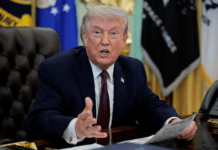
A senior Justice Department official instructed federal prosecutors across the country to draft plans to investigate a group funded by George Soros, the billionaire Democratic donor who President Trump has demanded be thrown in jail.
The directive, a copy of which was viewed by The Times, listed possible charges that could be filed against Soros’s foundation, including arson and material support of terrorism. It suggested that department leaders were following orders from Trump to investigate and prosecute figures he considers his enemies — an extraordinary breach of decades-old prosecutorial protocols. Here’s why Trump is targeting Soros’s foundation.
At the same time, Lindsey Halligan, a federal prosecutor in Virginia who was handpicked for the job by the president, is racing to present a case against the former F.B.I. director, James Comey. Halligan, a former White House aide who had no experience as a prosecutor before this week, is facing intense pressure from the White House to indict Comey.
Separately, federal prosecutors in Pennsylvania are trying, but struggling, to put together a criminal case against John Brennan, the former C.I.A. director whom Trump has attacked.
In other Trump administration news:
• In an unusual and unexplained directive, Defense Secretary Pete Hegseth summoned generals and admirals from around the world to meet on short notice next week.
• The White House threatened mass layoffs if the government shuts down next week, which Democrats said would not prompt them to drop their demands. Here’s what to know.
• The Social Security Administration is struggling to meet demand with a diminished work force.

The U.S. is offering a bailout for Argentina
Treasury Secretary Scott Bessent said that the Trump administration was prepared to extend a $20 billion lifeline to Argentina. The effort is intended to aid the country’s sputtering economy and help Javier Milei, Argentina’s embattled president, whom President Trump sees as a kindred political spirit.
But the politics of bailouts, which Republicans traditionally loathe, are precarious. Critics of the plan include not just Democrats but agricultural groups whose members have been hurt by Trump’s trade war with China and are anxiously waiting for economic support.

Abbas insists to the U.N. that ‘Palestine is ours’
In a remote address today to the U.N. General Assembly, Mahmoud Abbas, the president of the Palestinian Authority, said that no matter how much suffering the Palestinians endured, they would remain in Gaza and rebuild their land: “It will not break our will to survive.”
During the speech, in which he denounced the Hamas-led attack on Israel and criticized Israel’s military response, Abbas said the Palestinian Authority was willing to take responsibility for Gaza and that Hamas would have no part in governing the enclave after the war.
Abbas delivered his speech by video from the West Bank after the U.S. denied him a visa to attend the meeting in New York City.
In related news, Trump assured leaders of Arab and Muslim-majority nations this week that he would not allow Israel to annex the West Bank.
How cities are dealing with a warming world
The Earth is hot, and it’s only getting hotter — making summers increasingly unbearable in many parts of the world. We looked at more than a dozen cities around the world to see what has worked to provide some relief from the heat.
In Vienna, asphalt was painted different colors. In Cologne, Germany, people are misted as they walk down the street. In Basel, Switzerland, some people commute to work by river. And in Dubai, malls added running paths.