How California’s Voter Guide published a candidate’s antisemitic conspiracy theories

Date:

A close-up image shows the cover of an “Official Voter Information Guide” booklet resting on a surface. The shallow depth of field keeps the blue title graphic in focus while the rest of the booklet fades softly out of focus.

Guest Commentary written by

Reuven Taff

Reuven Taff is past president of the Sacramento Board of Rabbis and serves as rabbi emeritus of Mosaic Law Congregation in Sacramento.

Recently I received in the mail California’s Official Voter Information Guide. Before every election California’s Secretary of State mails voters an official guide explaining ballot measures and introducing candidates for statewide office. Most Californians assume the information inside meets at least some minimal standard of decency and truth.

Apparently not.

In the most recent guide, a gubernatorial candidate submitted a statement packed with antisemitic conspiracy theories, lies about 9/11, demonization of Israel and rhetoric portraying Jews as manipulative, murderous and subhuman.

The candidate’s statement was not merely controversial or offensive; it repeated some of the oldest antisemitic tropes, including “Planes did NOT destroy towers. Israel did” and “3,000 murdered to create new ‘Pearl Harbor’ to justify fighting wars for Israel.”

And the state of California printed it. Packaged it. Stamped it with the seal of an official government publication. Then mailed it to millions of voters at taxpayer expense.

Candidate statements are subject to only two restrictions: a 250-word limit and they must make no reference to opponents. They are otherwise printed verbatim, without editing for grammar, spelling or content.

In fact, among all the candidates who submitted statements for the voter guide, only this candidate’s statement carried a disclaimer: “The views and opinions expressed by the candidates are their own and do not represent the views and opinions of the Secretary of State’s office.”

That makes it clear that the office recognized the extraordinary and inflammatory nature of the material.

When I first read the statement, I was stunned. How could this possibly have passed through the office of California Secretary of State Shirley Weber without anyone stopping and saying this should never appear in an official state voter guide?

So I wrote to Dr. Weber asking what review process exists for candidate statements, whether there are standards beyond word count and formatting, and if anyone evaluates demonstrably false or hateful material before it is mailed statewide.

Days later came the response: a copy of Dr. Weber’s letter to Ron Galperin of the American Jewish Committee, who had raised many of the same concerns.

Weber’s letter reads less like courageous leadership and more like legal damage control. It relied on procedural explanations and bureaucratic rationalizations while avoiding the larger issue.

The Secretary of State’s office claims current law leaves little room to reject candidate statements. Perhaps that is true. But leadership is not measured only by what the law permits. Leadership requires the judgment to recognize right from wrong — and the courage to draw a line.

Even more troubling was Weber’s claim that the public had an opportunity to challenge the statement during a brief review period before publication. That argument falls apart under common sense. Ordinary Californians do not spend their days monitoring election review windows and legal notices. By the time many people became aware of the statement, the voter guides had already been mailed.

Some will argue this was merely the ranting of a fringe candidate with no realistic chance of being elected. But that misses the point. The issue is not the candidate’s political viability. Rather, it is the state of California’s decision to package and distribute hate-filled material under the banner of an official government publication.

Antisemitism has surged across California and throughout the country. Jewish students are harassed on campuses. Jewish businesses and organizations are targeted. Synagogues like mine — and others throughout the country — now require armed security.

Yet when antisemitic conspiracy theories appeared in an official state publication, California’s response amounted to “Our hands were tied.”

That response should alarm every Californian — Jewish or not.

Freedom of speech is not an excuse for government moral blindness. And protecting the First Amendment must not mean the state becomes a delivery system for hate-filled rhetoric.

Weber has indicated that her office and state lawmakers are discussing possible reforms. If so, those efforts should be pursued immediately and publicly.

Because what happened here was not merely a bureaucratic failure. It was a moral one.

EDITOR’S NOTE: Secretary of State Shirley Weber told Calmatters she condemns antisemitism but must uphold free speech rights and a state law that doesn’t allow her to reject candidate statements based on their content.

The candidate, Don Grundmann, a retired chiropractor who lives in Santa Clara County, told CalMatters he stands by his statement. He is registered as having no qualified party preference.


LEAVE A REPLY

Please enter your comment!
Please enter your name here

Share post:

Subscribe to The Hemet & San Jacinto Chronicle

Popular

More like this
Related

Even while courting moderates on voter ID, GOP leaders still push debunked fraud narrative

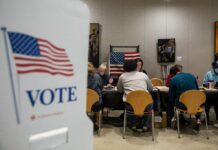
Election workers sit behind a table as they check in people sitting in front of them. A voting booth with the word

In summary

While GOP lawmakers try to convince moderates that a voter ID requirement is a “common sense” idea, they continue to push President Donald Trump’s debunked fraud narrative.

With President Donald Trump dragging them down in the polls, California Republicans are repackaging one of his core crusades into an idea they hope will be more palatable to voters.

They are framing their successful push to get a voter ID law on the November ballot as a “common sense” measure.

“We’ve structured this initiative based on what voters across the political spectrum would want,” Republican Assemblymember Carl DeMaio of San Diego said in a March interview, adding that showing an ID at the polls shouldn’t be any different than using one to buy alcohol or pass airport security.

DeMaio and other backers point to polling that shows 56% of California voters support requiring ID at the ballot box and that most states require or recommend an ID to vote. 

But even in their pursuit to appeal to moderates, GOP lawmakers haven’t given up pushing Trump’s debunked claims of widespread voter fraud. 

Last month, GOP legislators held a “stop the fraud” press conference, where they alleged without proof rampant corruption across state government, from elections to homelessness programs, and urged Newsom to call a special session to “audit” the alleged fraud. 

The polling they point to also shows, however, that support for requiring identification at the polls drops to 39% when voters are told it is backed by DeMaio and could suppress turnout.

Voting rights groups say the measure would create needless barriers and would stifle turnout among low-income and disabled voters.

Current law already requires counties to routinely review voter registration databases to remove anyone who is ineligible to vote in case of a move, incarceration or death.

“Those checks and that maintenance of that list is already happening,” League of Women Voters executive director Jenny Farrell said. “We don’t need to erect new barriers.”

Voter suppression concerns tank voter ID support

If passed, as many as 1 million eligible voters could be kept from voting. Another 500,000 aren’t registered and don’t have the necessary documents it would require, according to UCLA Voting Rights Project director Matt Barreto.

“There’s been a very consistent finding in almost any state, in any environment, that lower-income and working-class voters are less likely to have an updated, valid ID,” he said.

Labor groups who bankrolled Democrats’ campaign for last year’s redistricting proposal, Proposition 50, are funding a similar opposition campaign focused on Trump’s push for a proof-of-citizenship bill in Congress.

Meanwhile, Democrats want to increase penalties for violating election laws after Riverside County Sheriff Chad Bianco, a candidate for governor, seized hundreds of thousands of ballots earlier this year over baseless claims of voter fraud in the 2025 election.

Bianco, who seized the ballots in response to unproven claims from a right-wing activist group, supports voter ID.

Critics say he’s stoking fear among voters and that there are already adequate safeguards.

“We have a two-person rule where no ballots are ever in an area that’s not with at least two people observing what’s happening,” said Gail Pellerin, Democratic chair of the Assembly elections committee, at a UCLA elections panel last month.

Ramping up the base?

Experts agree voter fraud is rare.

However, fears about election integrity have risen among Republicans since Trump falsely claimed the 2020 election was stolen, spurring GOP lawmakers across the country to introduce bills seeking to tighten voter restrictions.

This is DeMaio’s third attempt at a voter ID ballot initiative. It qualified for the ballot last month.

A lawmaker, wearing a black suit with a striped yellow tie, stands behind a lectern while surrounded by people holding blue and yellow signs that say
Assemblymember Carl DeMaio announces that supporters of the CA Voter ID Initiative will submit more than 1.3 million signatures to qualify the measure for the November 2026 ballot during a press conference at the west steps of the state Capitol in Sacramento on March 3, 2026. Photo by Fred Greaves for CalMatters

Strategists say there’s little evidence that ballot initiatives actually turn out voters, but this measure is something intended to activate voters in what will likely be a difficult election year for Republicans.

“Issues like this, that are kind of red meat issues for Republicans when the governor’s race is fairly lackluster, it helps,” Stutzman said. “It’s all upside. It’s not going to hurt Republicans to have this on the ballot.”

Following bruising losses after Prop. 50 and in other states, GOP leaders are hoping to hold onto three statehouse seats they flipped in 2024 and gain others. But Trump — and his push for national voter restrictions — threatens Republicans’ success at the ballot box.

“It’s a loop that Republicans keep hammering on, either fraud or ineptitude, or waste in dollars,” Stutzman said. “It’s kind of traditional Republican messaging.”

For the Record: An earlier version misstated GOP lawmakers’ call for Gov. Gavin Newsom to call a special session on alleged fraud.

Does that influencer really like Tom Steyer?

It can start subtly enough: One day a social...

What are they trying to hide? California lawmakers kill lobbying transparency bills

In summary Good government groups backed legislation that sought to...